
AI
Contributing to a sustainable society through Physical AI that understands people, objects, and events in the physical world and operates autonomously in collaboration with humans.
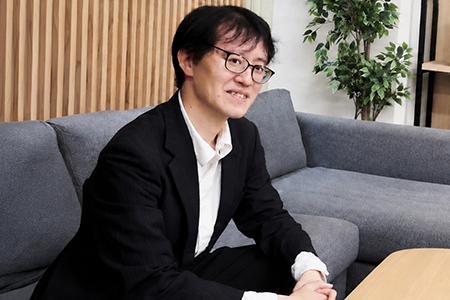
Mori Kurokawa
General Manager
AI Division
Enabling AI That Is More Accessible and Trustworthy
The AI Division is engaged in research and development aimed at realizing AI that is more accessible and trustworthy, enabling personalized support and enhanced operational efficiency. Building on our research achievements in AI, data analytics, and communication technologies, we are advancing next-generation AI agents that enhance three dimensions of closeness in the physical world: spatial understanding, behavioral understanding, and natural interaction. We are creating AI agents capable of [Spatial Understanding] sensing subtle changes in the environment, [Behavioral Understanding] understanding users' situations and intentions, behaving accordingly, and [Natural Interaction] delivering accurate responses with the naturalness of human conversation. Through streamlining and advancing the development process for these AI agents, as well as deploying them in robots, drones, and other physical platforms, we contribute to solving a wide range of societal challenges, including labor shortages.
Research Themes
Perception AI Agents
- We build perception AI systems that monitor the user's surroundings from various angles using cameras, drones, and robots, and provide advanced situational awareness to users and AI systems.
Action AI Agents
- We build autonomous action control systems that understand user needs and intentions, enabling robots to assist with daily life and plan and execute tasks on behalf of users.
Conversation AI Agents
- We build communication systems that formulate optimal conversational strategies based on an understanding of the user’s intentions and personality gained through dialogue, and conduct accurate conversations by incorporating necessary background knowledge.
Neurotechnology in the Era of Generative AI
- Envisioning an era where humans and AI collaborate naturally and seamlessly, we establish a neurotechnology framework that enables the "co-evolution of humans and AI" by promoting human growth through feedback from AI and advancing the evolution of AI by incorporating human thinking and judgment.
News Release&Topics
|
|
|
Publications
RCPU: Rotation-Constrained Error Compensation for Structured Pruning of Large Language Models
Shuichiro Haruta, Kazunori Matsumoto, Zhi Li, Yanan Wang, Mori Kurokawa
2026 The Fourteenth International Conference on Learning Representations (ICLR 2026)
April 2026
Dialogue Control and Its Consequences: Grounding, Policy, and User Perception in Persuasive Chatbots
Roberto Legaspi, Donghuo Zeng, Kazushi Ikeda
2026 CHI Conference on Human Factors in Computing Systems (ACM CHI 2026)
April 2026
Learning Audio–Visual Embeddings with Inferred Latent Interaction Graphs
Donghuo Zeng, Hao Niu, Yanan Wang, Masato Taya
The 48th European Conference on Information Retrieval (ECIR 2026)
March 2026
Personality-Aware Reinforcement Learning for Persuasive Dialogue with LLM-Driven Simulation
Donghuo Zeng, Roberto Legaspi, Kazushi Ikeda
The 21st International Conference on Persuasive Technology (Persuasive 2026)
March 2026
Estimating the Perceived Burden of Disaster Preparedness Using Location Data: An Exploratory Study
Mizuki Miura, Zhixiong Chen, Akihiro Kobayashi, Masato Taya, Daisuke Kamisaka
The 21st International Conference on Persuasive Technology (Persuasive 2026)
March 2026
Awards
2021.11.10
18th EAI International Conference on Mobile and Ubiquitous Systems: COmputing, Networking and Servicies (Mobiquitous 2021)「Best Paper Award」
Event Detection and Event-Relevant Tweet Extraction with Human Mobility
Naoto Takeda, Daisuke Kamisaka, Roberto Legaspi, Yutaro Mishima, Atsunori Minamikawa