 Print
KDDI Research Releases Ransomware Recovery Tool for Linux Systems as Open-Source Software
—Helping Organizations Recover Files Encrypted by Ransomware—
October 16, 2026
KDDI Research, Inc.
KDDI Research, Inc. (KDDI Research) has developed a ransomware recovery tool to restore files encrypted by ransomware (Note 1) targeting Linux servers and cloud infrastructure. The tool was released as open-source software (OSS) on October 16, 2026. During normal system operation, the tool continuously records pseudorandom numbers (Note 2), which ransomware may use to generate encryption keys. After a ransomware attack, the tool reconstructs the encryption keys from the recorded pseudorandom numbers and uses them to restore the encrypted files to their original state.
By making the tool widely available, KDDI Research aims to support enterprise security operations and strengthen cyber resilience across society.
Research findings related to the tool were presented at the Computer Security Symposium 2026 (CSS 2026), held from October 19 to 23, 2026 (Note 3).
Background
・In recent years, ransomware attacks have become increasingly damaging, targeting not only Windows devices but also Linux systems that support mission-critical business operations and cloud infrastructure. Major ransomware groups continue to develop new variants, and disruptions to Linux systems can bring operations across entire organizations to a halt, posing a significant challenge to society.
・Conventional countermeasures against cyberattacks, such as threat detection and file backups, have been widely adopted. However, sophisticated attacks can evade detection or delay detection, while backups may also be encrypted, making file recovery difficult or even impossible.
・KDDI Research has been conducting research and development on technologies for detecting and countering cyberattacks. In February 2026, KDDI Research announced the development of KWAF, a security technology designed to protect systems against previously unknown cyberattacks (Note 4). In April 2026, KDDI Research established Cyber Intelligence Laboratories (Note 5) to strengthen its efforts to counter cyberattacks.
Tool Overview
| Tool Name | Memento |
|---|---|
| Source Code URL | https://github.com/KDDIR-SEC/memento |
| License | GPL-2.0-only |
| Recommended Environment | OS: Ubuntu 24.04 LTS Kernel: Linux 6.17.0-35-generic CPU: Intel x86-64 |
Key Features
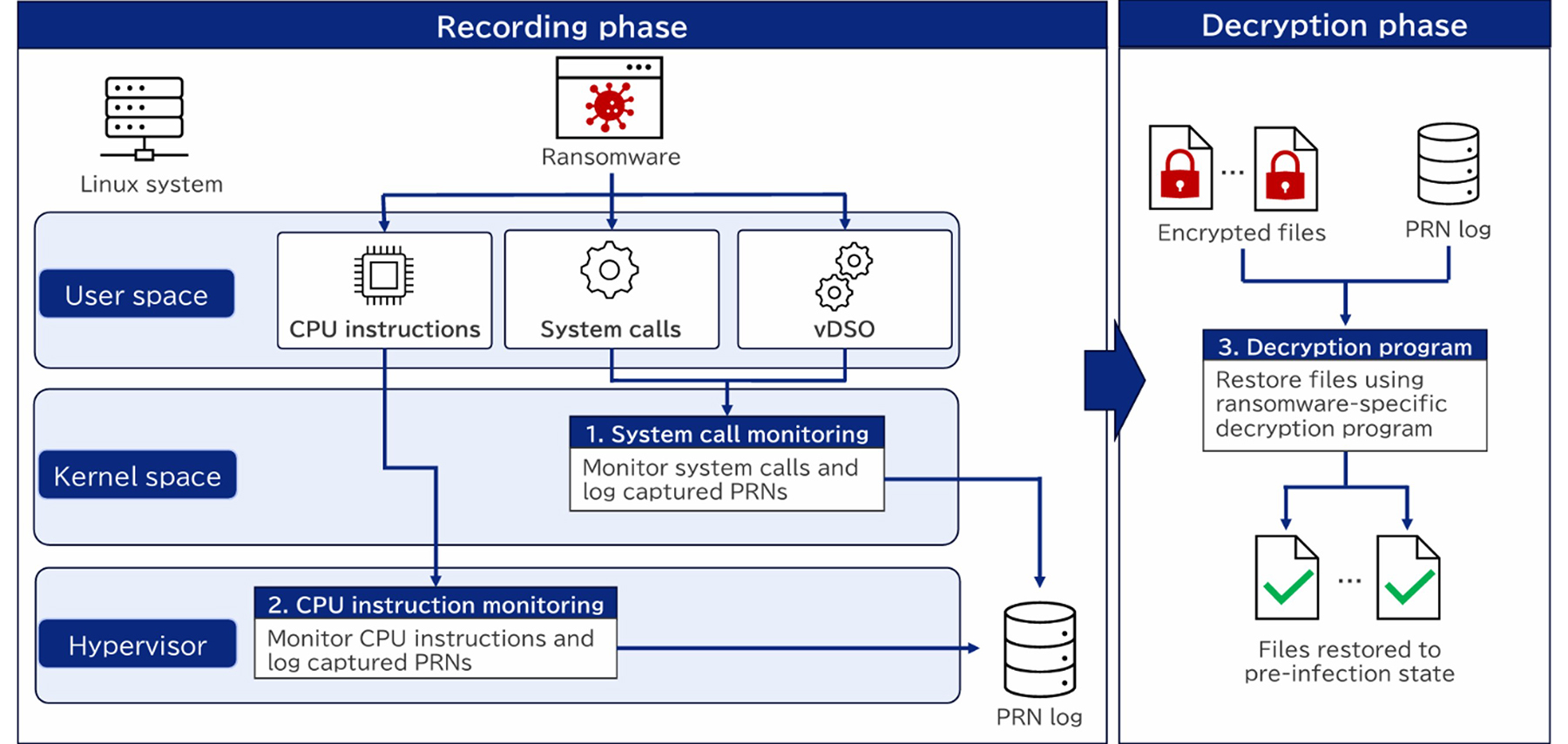
The tool consists of two phases: a recording phase and a decryption phase.
・Recording phase
Linux systems provide multiple ways for user-space processes to obtain pseudorandom numbers, which ransomware may use to generate encryption keys. Through analysis of real-world ransomware families, including Qilin, Babuk, DragonForce, and Prince, KDDI Research identified three types of pseudorandom number acquisition methods used by Linux ransomware: CPU instructions, system calls, and vDSO (Note 6). Based on these findings, KDDI Research developed a monitoring program that comprehensively monitors all three methods (patent pending). The captured pseudorandom numbers are recorded in logs for use during the decryption phase.
・Decryption phase
After a ransomware attack, the tool generates multiple candidate encryption keys from the recorded pseudorandom numbers. It then attempts to decrypt the files using these candidate keys and assesses whether the files have been successfully restored based on their file formats and data entropy (a measure of randomness). This process enables the tool to recover files in their pre-encryption state (patent pending).
Experimental Results Using Ransomware Simulations
To evaluate the practical applicability of the tool, experiments were conducted involving 100–500 files on a Linux system using safe test programs that simulate two major ransomware families, Qilin and Babuk.
・Qilin simulation
For Qilin, the tool reconstructed encryption keys from pseudorandom numbers recorded during file encryption by the test program. All encrypted files were successfully restored, with recovery taking 0.36 hours for 100 files and 45 hours for 500 files.
・Babuk simulation
For Babuk, reconstructing the encryption keys requires identifying the public key (Note 7) of the ransomware, in addition to the pseudorandom numbers. KDDI Research developed and evaluated a method for extracting public key candidates from process memory dumps (Note 8) of the Babuk test program, achieving an accuracy of 99.9% in identifying the public key required for recovery. When the public key was correctly identified, all encrypted files were successfully restored, with recovery taking 11 hours for 100 files and 54 hours for 500 files.
(Note 1) A type of malware that encrypts files, making them inaccessible, and demands a ransom in exchange for restoring access to them.
(Note 2) Computer-generated numbers that appear random and are extremely difficult to predict. Ransomware uses these numbers to generate encryption keys.
(Note 3) An academic symposium organized by the Special Interest Group on Computer Security of the Information Processing Society of Japan.
Computer Security Symposium 2026
(Note 4) Press release on February 18, 2026: “Development of KWAF, a Security Technology to Protect Systems Against Unknown Cyberattacks.” (in Japanese only)
(Note 5) Cyber Intelligence Laboratories.
(Note 6) A virtual dynamic shared object (vDSO) is a mechanism that enables certain Linux kernel functions to be executed in user space. The vDSO-based method allows pseudorandom numbers to be generated in user space without using system calls.
(Note 7) A public key is one of the keys used in public key cryptography. Some ransomware families, including Babuk, use a public key together with pseudorandom numbers to derive encryption keys.
(Note 8) A copy of the memory contents of a running process.
※The information contained in the articles is current at the time of publication.Products, service fees, service content and specifications, contact information, and other details are subject to change without notice.