 Print
Print
KDDI Research Ranks No. 1 Worldwide on a Global Real-Robot AI Benchmark
—Integrating knowledge from multiple VLA models with action prediction enables stable autonomous operation of physical robots—
October 5, 2026
KDDI Research, Inc.
KDDI Research, Inc. (KDDI Research) announced on October 5, 2026, that it has taken first place worldwide (Note 1) in "Table 30 V2," the latest evaluation track of RoboChallenge (Note 2), a global benchmark for robot AI.
RoboChallenge is the world's largest platform for evaluating robot AI on physical robots. It attracts participants from around the globe—including major Chinese tech companies at the forefront of the physical AI market and leading humanoid robot developers—and more than 100,000 real-robot tests have been conducted on it to date. The Table 30 V2 track focuses on hands-on robotic manipulation, measuring how well AI models perform on physical robots in real-world settings, including challenging tasks such as bimanual coordination and handling deformable objects.
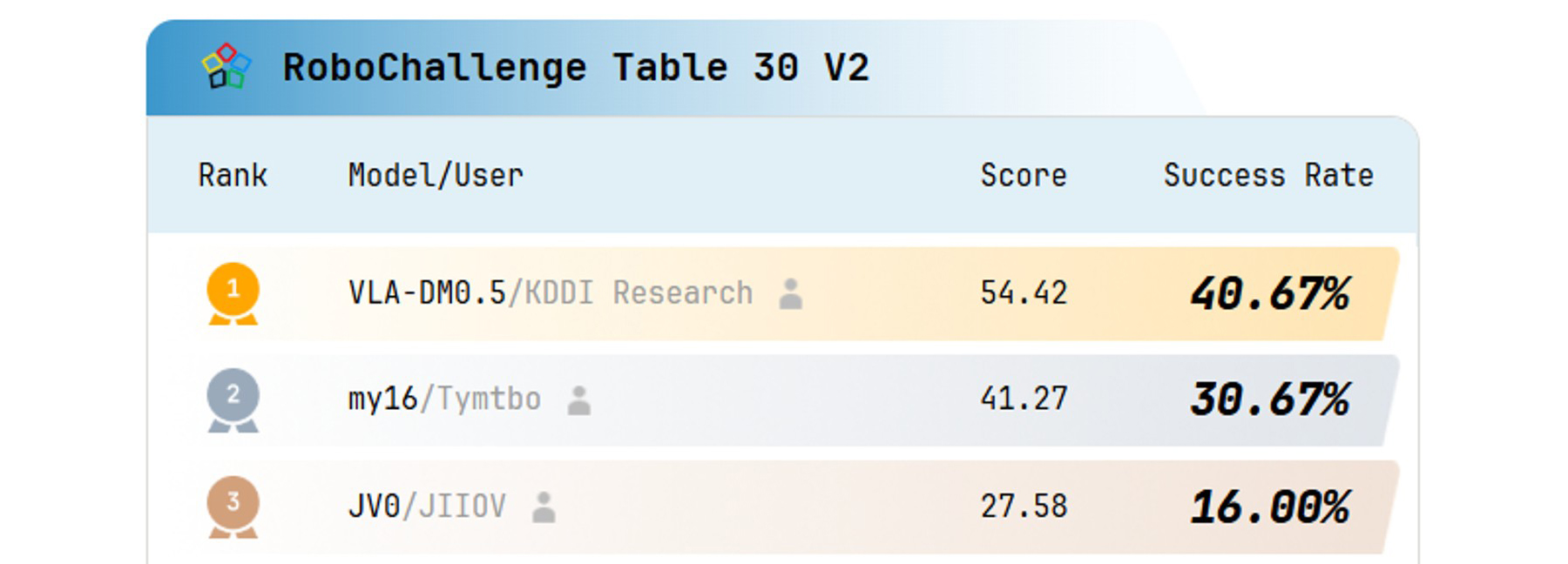
<Leaderboard rankings (as of October 5)>
This result was achieved with a proprietary technology that builds on the image recognition and scene understanding expertise KDDI Research has developed over many years. The technology combines two elements: knowledge integration across multiple VLA (Vision-Language-Action) models, and action optimization that uses a "world model"—which predicts the outcomes of robot actions—to select the best action. By dynamically choosing the motions and speeds most likely to succeed in each situation, the technology adapts readily to a wide variety of tasks and enables stable autonomous operation in real-world environments. In developing the technology, KDDI Research also leveraged multiple VLA models, including Dexmal's open-source DM0.5 (Note 3), to further improve task success rates.
■ Technology Overview
The technology consists of two core components:
● Knowledge integration: When integrating knowledge into generative AI models such as LLMs (Large Language Models) and VLMs (Vision Language Models), the conventional approach has been to train a model to faithfully reproduce the outputs of a stronger model. Robot actions, however, have a distinctive characteristic: a robot does not have to replicate the exact same motion, as long as it ultimately completes the task. Building on this insight, KDDI Research's approach closely follows the stronger model's actions at moments that are critical to task success, while allowing flexibility elsewhere. By selectively integrating the know-how that each VLA model excels at for a given task—such as how firmly to grip an object or when to switch hands—KDDI Research has built a high-performance model that combines the strengths of multiple VLA models and can handle a wide range of tasks.
● Action optimization: For each action plan generated by the enhanced VLA models, the technology uses a "world model"—an AI that understands real-world physics and cause-and-effect relationships—to predict in advance how the robot would move if it executed that plan, and whether that would lead to task success. Based on these predictions, it selects the action with the highest likelihood of success and dynamically adjusts motion speed to suit the task and situation.
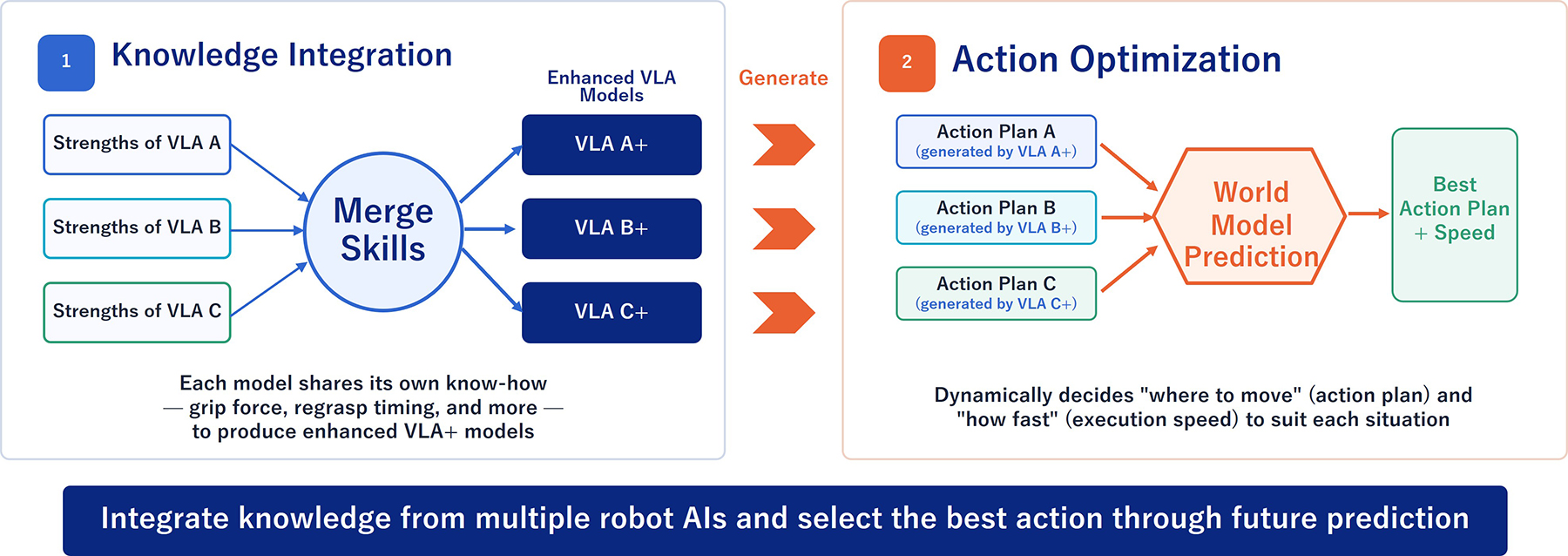
<Conceptual diagram of the technology>
<Example task: Opening a shelf door and placing an object inside>
In participating for RoboChallenge, KDDI Research conducted preliminary evaluations on physical robots and explored model tuning with the support of Professor Jiang Liu of the Global Center for Science and Engineering, Faculty of Science and Engineering, Waseda University.
■ Future Outlook
KDDI Research will apply this technology to its project under GENIAC (Note 4), which aims to develop robot foundation models capable of taking over frontline operations in industries such as retail and logistics. Through this work, KDDI Research will accelerate the real-world deployment of physical AI that can flexibly handle a wide variety of tasks with a single system. By expanding support for a broader range of robots and tasks, KDDI Research aims to bring physical AI into practical use in fields such as retail, logistics, manufacturing, and facility maintenance.
(Note: 1) As of October 5, 2026. The rankings are published on the RoboChallenge website (RoboChallenge). As many companies are actively conducting real-robot tests in this track, success rates are updated daily and the rankings are subject to change.
(Note: 2) RoboChallenge Table 30 V2: An international benchmark that evaluates the performance of AI models on physical robots in real-world settings, using four types of robots and 30 real-world tasks.
(Note: 3) DM0.5: An open-source VLA model released by Dexmal. It interprets visual input and natural-language instructions to generate robot actions.
(Note: 4) GENIAC (Generative AI Accelerator Challenge) : A program jointly implemented by the Ministry of Economy, Trade and Industry (METI) and the New Energy and Industrial Technology Development Organization (NEDO) to strengthen Japan's generative AI development capabilities and promote its adoption across society.
※The information contained in the articles is current at the time of publication.Products, service fees, service content and specifications, contact information, and other details are subject to change without notice.