 Print
"Distributed AI" Achieves Autonomous Area Optimization in Line with Changing Congestion throughout the Day
―Looking ahead to the AI-Native Society, improving uplink speed during congestion by 60% and reducing low-speed areas by 30%―
October 14, 2026
KDDI Corporation
KDDI Research, Inc.
Tokyo, October 14, 2026―KDDI and KDDI Research conducted a demonstration (hereinafter referred to as the demonstration) from June to August 2026 on part of the commercial network across Japan. In the demonstration, telecommunication areas were optimized in line with the telecommunication status at each time of day using a technology in which multiple AIs cooperate to autonomously optimize base station settings (hereinafter referred to as "distributed AI").
In the AI-Native Society, uplink speed is becoming increasingly important as the use of AI and video data expands. Against this backdrop, the demonstration succeeded in improving uplink speed in congested telecommunication areas by approximately 60% on average and reducing low-speed areas for uplink telecommunication by approximately 30%.
Based on the results of the demonstration, the two companies will incrementally introduce this distributed AI, which optimizes telecommunication areas by time of day, to the commercial network across Japan from November 2026, with full-scale operation starting within FY2026.
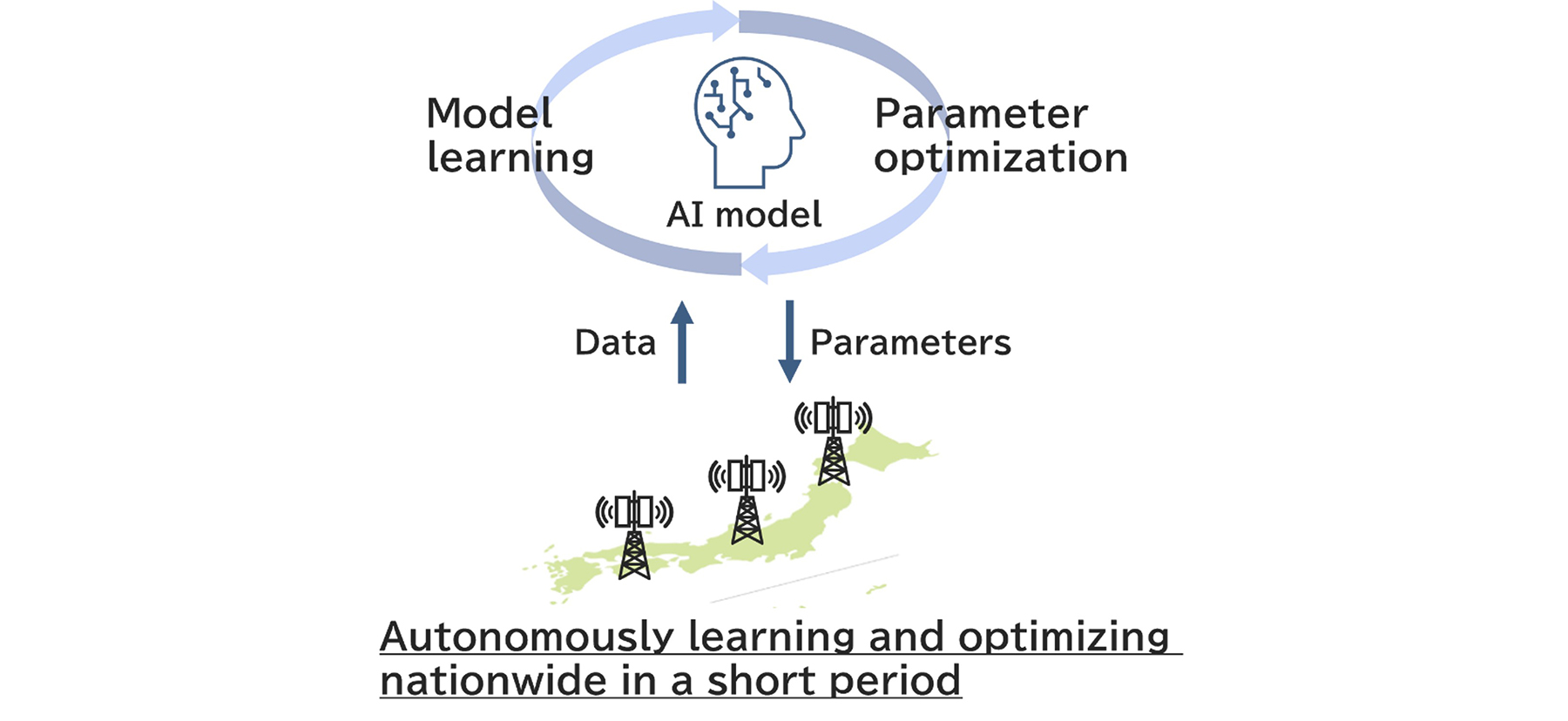
<Optimization of telecommunication areas by distributed AI>
For the AI-Native Society, KDDI is promoting the "Digital Belt" Initiative, which aims to build a nationwide low-latency network and AI computing resource infrastructure covering the land, sea, and air across Japan by integrating assets such as data centers and submarine cables with technologies such as APN and 6G.
The demonstration is one of the initiatives under the Digital Belt Initiative to make the network infrastructure highly autonomous. The Digital Belt is social infrastructure that supports the enormous demand for AI in the AI-Native Society. At the same time, it is next-generation infrastructure that is highly refined by AI technology. By utilizing AI technology to make the infrastructure itself more sophisticated and autonomous, KDDI and KDDI Research will contribute to the advancement of the AI-Native Society, as well as to the realization of the 6G era, in which networks will become even more autonomous and AI-driven.
■ About the demonstration
1.Background and challenges
In the era of "Physical AI," in which mobility such as robots, autonomous vehicles, and drones moves through the real world based on AI decisions, uplink telecommunication, which sends video and sensor data to AI, is becoming even more important.
In February 2026, KDDI introduced distributed AI to base stations in certain areas, achieving improved telecommunication quality through area optimization and reduced work time for optimization (Note), and has now completed its nationwide rollout.
Further improving and stabilizing telecommunication quality requires "optimization by time of day" in line with congestion that changes significantly over the course of a day. Optimization by time of day requires analyzing an enormous amount of data around base stations, which fluctuates from hour to hour, together with the combinations of parameter settings, and deriving the optimum setting values from this analysis had reached its limits both technically and operationally.
2.Features of distributed AI
・Distributed AI calculates the optimum setting values of base stations based on distributed reinforcement learning, in which multiple AIs cooperate in learning. The optimization is performed through the coordination of "inference engines," which infer and apply setting values for individual base stations, and a "learning engine," which learns and shares knowledge common among the inference engines from their experience.
・In the demonstration, a technology that compresses the number of dimensions of input data with high efficiency was newly introduced so that distributed AI can efficiently learn the telecommunication status at each time of day. Using a compression model created in advance from the data of base stations across Japan, the enormous amount of hourly data is converted into low-dimensional data by reducing redundant information while retaining the features required for optimization. As a result, the number of dimensions of the input data to the inference engines was reduced to approximately one-tenth, and the learning time was shortened to approximately one-fifth.
This dimensionality compression has made it possible for distributed AI to autonomously optimize setting values. The demonstration confirmed that uplink speed during congested hours can be improved by approximately 60% on average and that low-speed areas can be reduced by approximately 30%.
3.Details of the demonstration
・Period: June 2026 to August 2026
・Environment: KDDI's commercial network
・Scale: 100 congested areas selected across Japan
・Target setting: Amount of control signal resources allocated to each smartphone (device)
Control signals are signals by which a base station instructs smartphones "when and on which radio resources to send and receive data." During congested hours, resources for control signals may be insufficient, causing data transmission speed to drop because instructions for sending and receiving data do not reach all smartphones.
In the demonstration, distributed AI autonomously determined the amount of control signal resources for each time of day in order to improve uplink speed and reduce low-speed areas. Specifically, during congested hours, control signal resources are allocated to each smartphone as needed, thereby increasing opportunities for data transmission and reception, while during off-peak hours, allocating them with extra margin enhances connection stability.
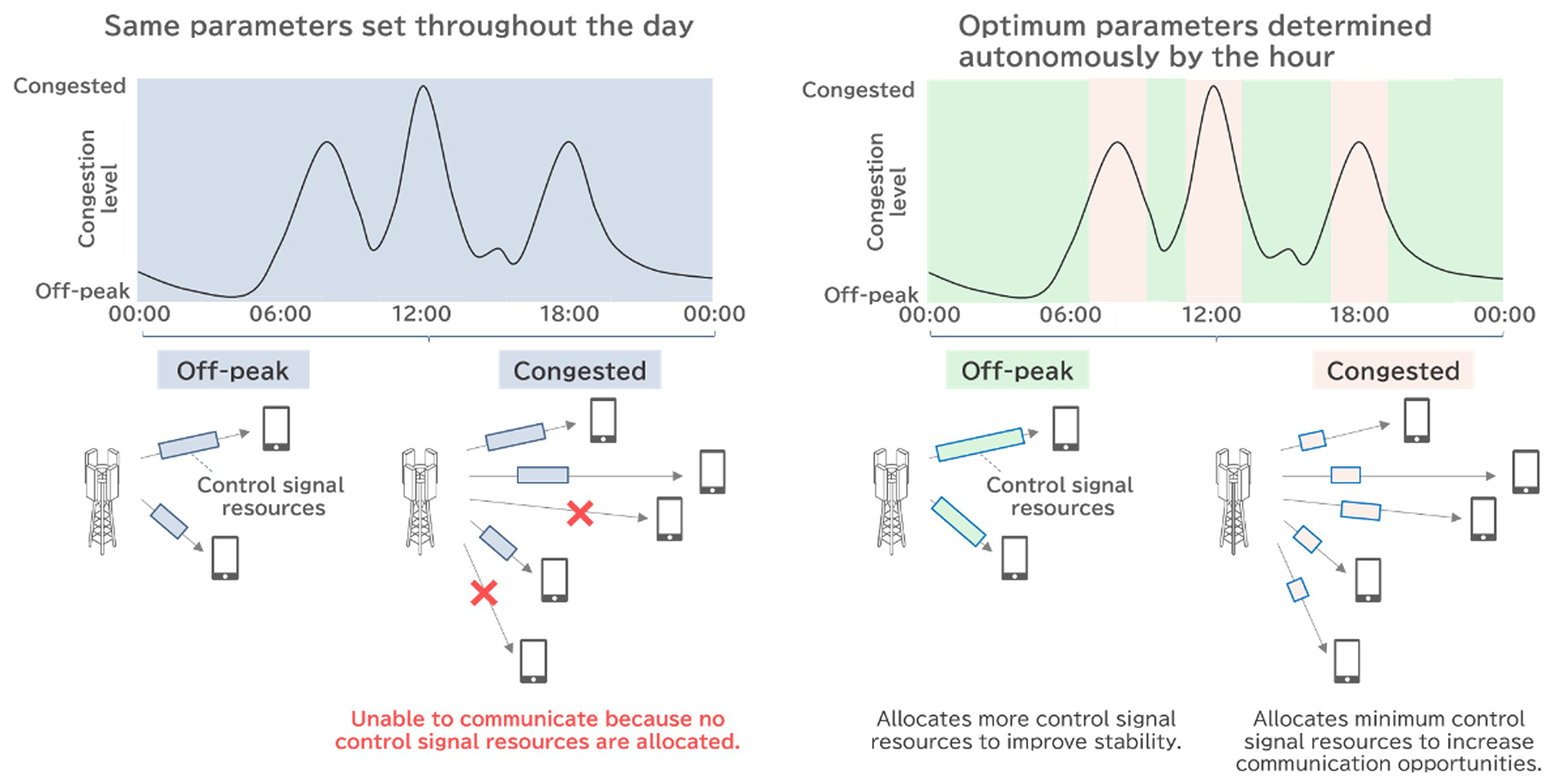
<Comparison of conventional parameter settings and parameter settings by time of day>
4.Results of the demonstration
・Uplink speed during congested hours
With the shortage of control signal resources resolved and data signal resources allocated to smartphones, uplink speed during congested hours improved by approximately 60% on average.
・Low-speed areas for uplink telecommunication
The number of areas where uplink speed had been 1.5 Mbps or less was reduced by approximately 30%, making data uploads more stable.
With improved uplink speeds, waiting times for posting photos and videos or uploading data to the cloud are shortened, and video footage delivered during web meetings and video calls is less likely to be interrupted, resulting in clearer content.
Distributed AI technology, which enables the network itself to keep optimizing in response to ever-changing telecommunication demand, contributes to realizing the telecommunication infrastructure that supports the social implementation of Physical AI.
5.Roles of each company
・KDDI Corporation:
Selection of the base station parameters subject to autonomous adjustment, and rigorous verification and evaluation of effectiveness on the commercial network
・KDDI Research, Inc.:
Design and development of a distributed reinforcement learning model that efficiently learns the optimum setting values even in a complex commercial network that changes in real time
■ About lectures and exhibitions on distributed AI
Kazuyuki Yoshimura, Senior Managing Executive Officer, CTO and General Manager, Core Technology Sector, KDDI, and Toshiaki Yamamoto, Executive Director, Wireless Technology Division, KDDI Research, will speak about distributed AI in sessions on October 14 at "CEATEC 2026," which will be held from October 13 to 16, 2026.
In addition, distributed AI will be exhibited at "KDDI SUMMIT 2026" (venue: TAKANAWA GATEWAY Convention Center), one of the largest business events of the KDDI Group, to be held on October 27 and 28, 2026. Advance registration (free of charge) is required to participate. For more details, please visit the special website for "KDDI SUMMIT 2026."
■ Related articles
KDDI Tech note: Dynamically Optimizing Base Stations in Line with Waves of Congestion ―Distributed AI, the Next Evolution― (in Japanese only)
(Note) News release dated February 18, 2026
Area Optimization Technology in Which Multiple AIs Cooperate Being Introduced at Base Stations across Japan
※The information contained in the articles is current at the time of publication.Products, service fees, service content and specifications, contact information, and other details are subject to change without notice.