 Print
Print
Successful Demonstration of "Intelligent 4D Resource Optimization" for 6G: High-Quality Communications with Energy Efficient Base Station
May 20, 2026
KDDI Research, Inc.
KDDI Research, Inc. (“KDDI Research”) has developed a base station technology for realizing sustainable 6G, called “Intelligent 4D Resource Optimization Technology” (hereinafter “this technology”), and successfully conducted a proof-of-concept trial (hereinafter “this trial”) on April 20, 2026 with Nokia Solutions and Networks Oy (headquaters: Espoo, Finland; Head of External Communication & Marketing: Rick Foote). This is the world’s first initiative (Note 1) to combine four-dimensional resources to simultaneously achieve high-quality communications and reduced base station power consumption on commercial equipment.
This trial was conducted at Nokia Bell Labs (headquarters: Murray Hill, New Jersey, USA; President: Peter Vetter) in the United States in an environment emulating commercial 5G deployment. As a result, the companies confirmed that this technology can reduce base station power consumption by up to approximately 40% at the same throughput levels, and support up to approximately 4.0 times throughput without increasing power consumption compared to existing 5G base station equipment.
This technology will also contribute to “ultra-low power consumption,” one of the key technical requirements cited in the Ministry of Internal Affairs and Communications’ technology strategy for Beyond 5G (6G).
Going forward, the two companies will work toward standardization of this technology in the 3GPP 6G specifications.
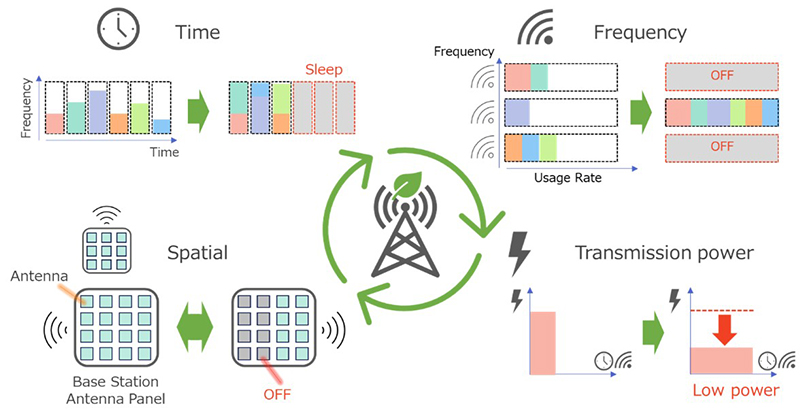
Concept of Intelligent 4D Optimization Technology
■ Background
With the expansion of video streaming, cloud services, and IoT, communications traffic has been increasing year by year. In the 6G era, the widespread use of new services such as AI is expected to generate data volumes far exceeding those of today. To realize mobile networks in the 6G era, it will be necessary to scale up and densify base station equipment to enhance communication performance, which will in turn increase the number of base stations. As a result, there is growing concern about the overall power consumption of networks, particularly that of base stations.
The KDDI Group has set a goal of achieving both improved communication quality and carbon neutrality. Rather than simply pursuing higher speed and larger capacity for 6G, the KDDI Group aims to establish network technologies that can simultaneously deliver “high quality” and “low power consumption.”
Against this backdrop, KDDI Research, which conducts advanced R&D with a focus on telecommunications, and Nokia Bell Labs, Nokia’s award-winning industrial research lab, concluded a joint research agreement on 6G in November 2025 (Note 2) and have been working together on the development of new technologies for the practical implementation of 6G. One of the themes of this joint research is the development of technologies that can simultaneously improve the communication quality of 6G base stations and reduce their power consumption.
■ Overview of Technology
Conventional base station control has optimized the four key radio resources—time, frequency, space, and transmission power—individually or only in a limited, partially coordinated manner.
<Four Resources for Base Station Control>
| Resource | Method for Reducing Power Consumption |
|---|---|
Time | Multiple data packets are aggregated and transmitted in a short period to secure time during which the base station can be placed in a power-saving (i.e., sleep) mode. |
Frequency | The frequency bandwidth in use is minimized in accordance with traffic conditions, and the radio circuits for unused bands are shut down. |
Space | Depending on user distribution and traffic conditions, the power supply to unnecessary antennas among the many mounted on the base station is turned off. |
Transmission power | Transmission power is allocated only as needed, in accordance with each user’s communication conditions. |
Control of these resources affects throughput. To simultaneously achieve reduced base station power consumption and maintain high communication quality, it is necessary to balance the control of these four resources and minimize the impact on throughput. This technology enables optimal, integrated control of all four resources in accordance with the radio environment and throughput requirements.
For example, this technology makes it possible to implement control schemes that were not feasible with conventional methods, such as actively using more time and frequency resources while suppressing transmission power and reducing the number of active antennas.
■ Overview of the Demonstration Trial
Trial Period:One month from March 2026
Location:
Nokia Bell Labs (Murray Hill, New Jersey, USA)
Radio anechoic chamber emulating a commercial 5G deployment
Trial results:
・Reduction of base station power consumption by up to approximately 40%
・Support up to approximately 4.0 times throughput without increasing power consumption compared to existing 5G base station equipment
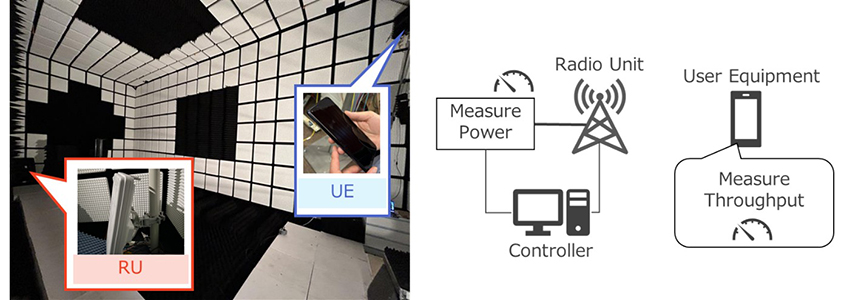
Demonstration set up
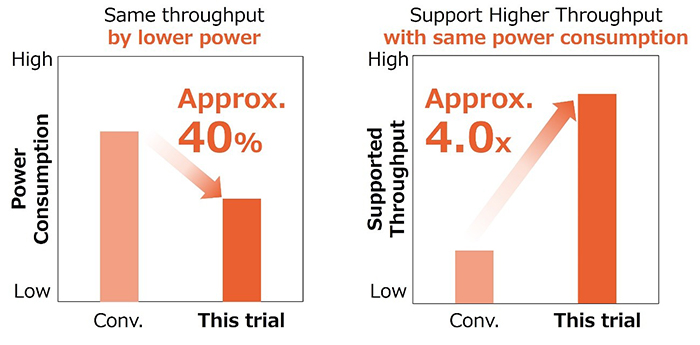
Demonstration results
■ Future Outlook
On April 23, 2026, the two companies concluded a new joint research agreement.
Harish Viswanathan, Head of the Radio Systems Research Lab at Nokia Bell Labs, said, "Novel energy efficiency mechanisms will become increasingly important for mobile networks as generative, agentic and physical AI traffic with different levels of burstiness become a significant portion of traffic. This lab trial demonstrated that significant energy savings are achievable through a combination of antenna muting and power control coupled with traffic load dependent intelligent time and frequency resource allocation, paving the way for scalable, energy efficient mobile networks in the future.”
Going forward, they will build on this technology—which is expected to serve as a fundamental technology for reducing the environmental impact of mobile networks—and apply it to research even more energy-efficient 6G network technologies by coordinating multiple base stations and frequency bands.
KDDI Research will also present the results of this demonstration at “Wireless Japan × Wireless Technology Park 2026,” to be held at Tokyo Big Sight (Koto-ku, Tokyo) from May 27 to 29, 2026.
(Note 1)The world's first integrated control method that combines four-dimensional resources to minimize the impact on throughput on commercial equipment. According to KDDI Research, Inc., as of May 20, 2026.
(Note 2)November 6, 2025 Press Release:
KDDI Research and Nokia Bell Labs Conclude a Joint Research Agreement for R&D Towards the Practical Application of 6G
※The information contained in the articles is current at the time of publication.Products, service fees, service content and specifications, contact information, and other details are subject to change without notice.